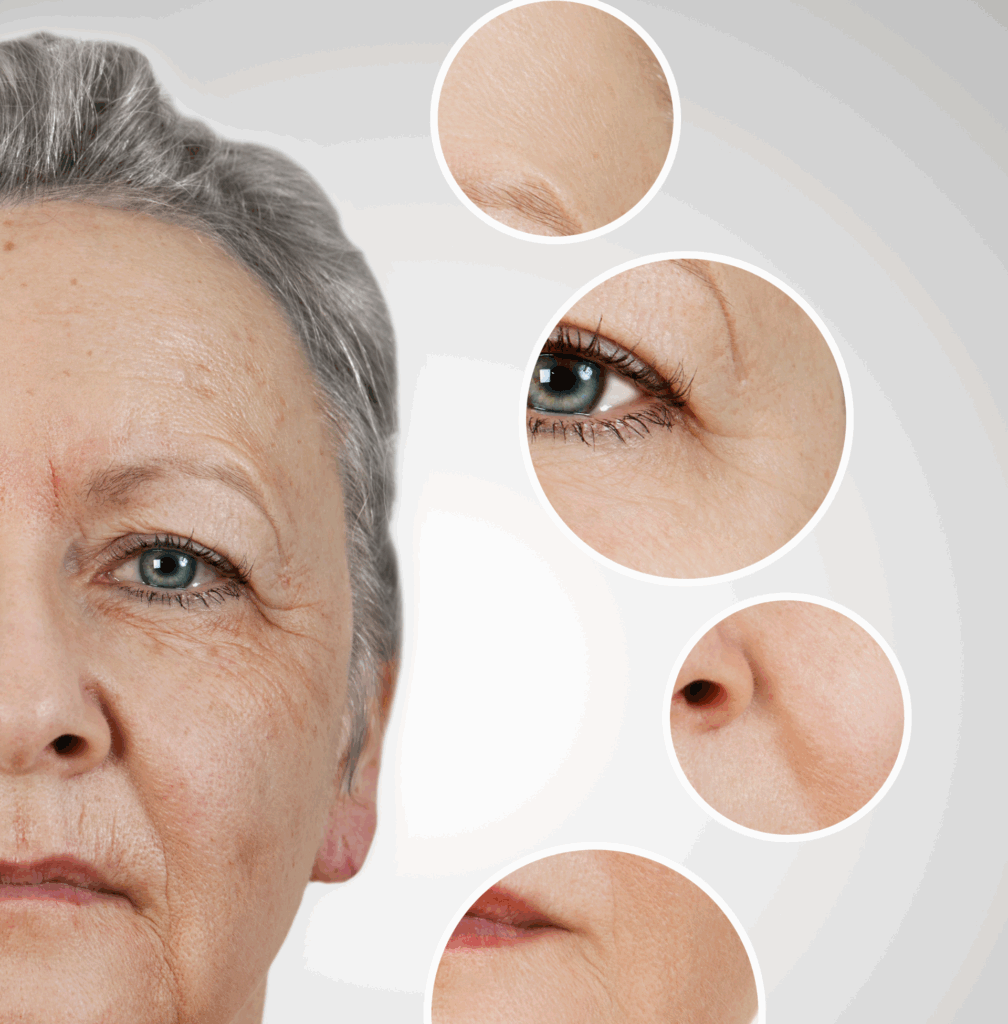
Loss of collagen and elastin: Skin becomes thinner and less elastic.
Reduced oil production: Leads to dryness and more visible lines.
Slower cell turnover: Dead skin cells accumulate, making skin look dull and aged.
Sun exposure (Photoaging): UV rays break down collagen and elastin, causing deep wrinkles and pigmentation.
Smoking: Reduces blood flow to the skin, damages collagen, and leads to early wrinkles.
Repeated facial expressions: Smiling, frowning, squinting—all cause lines over time due to repetitive muscle movement.
Poor nutrition: Lack of antioxidants and hydration affects skin health.
Pollution: Triggers inflammation and oxidative stress.
Sleep habits: Pressing your face against a pillow nightly can lead to “sleep lines.”
| Type | Description | Common Locations |
|---|---|---|
| Dynamic Wrinkles | Form due to muscle movement (expression lines). Become more visible with time. | Forehead lines, crow’s feet, frown lines (glabellar lines), smile lines |
| Static Wrinkles | Visible even when your face is at rest. Often due to loss of skin elasticity and collagen. | Nasolabial folds, cheeks, neck |
| Fine Lines | Shallow, surface-level lines from dehydration or early aging. | Under eyes, around the mouth |
| Deep Wrinkles | More pronounced creases from long-term aging and volume loss. | Between eyebrows, deep nasolabial folds, jowls |
| Sleep Wrinkles | Caused by pressure and folding of the skin during sleep. | Sides of the face, chest (in women) |
| Gravitational Folds | Result of sagging skin due to gravity and volume loss. | Jowls, neck, under eyes |
Glabellar lines: Between eyebrows (“11 lines”)
Nasolabial folds: From the nose to mouth corners
Marionette lines: From the mouth to the chin